

Peloton has acquired Skōp, the maker of a $7,995 connected Pilates reformer, in what the company is framing as a targeted acquisition of technology and expertise rather than an immediate new product for its lineup.
Rather than adding Skōp’s reformer as a Peloton-branded product as part of the announcement, Peloton says this acquisition was made for the underlying technology and expertise to fold into its R&D team – and as part of an investment into the “future of Pilates.”
Peloton shared:
“Pilates has long been a foundational pillar of fitness, and as demand for the modality continues to accelerate, we’re enhancing our R&D efforts in the category with the strategic acquisition of Skōp. As an early innovator in connected Pilates, Skōp brings foundational technologies and deep expertise that will build on Peloton’s leadership in at-home Pilates, help us push further into strength and scale our comprehensive wellness ecosystem.”
“Pilates is a category ripe for the same kind of experiential reinvention we brought to cardio,” Peloton CEO Peter Stern said. He added that Skōp “adds differentiated technology and specialized knowledge to our R&D team,” and that “form is everything in Pilates,” pointing to a focus on safe, effective technique.
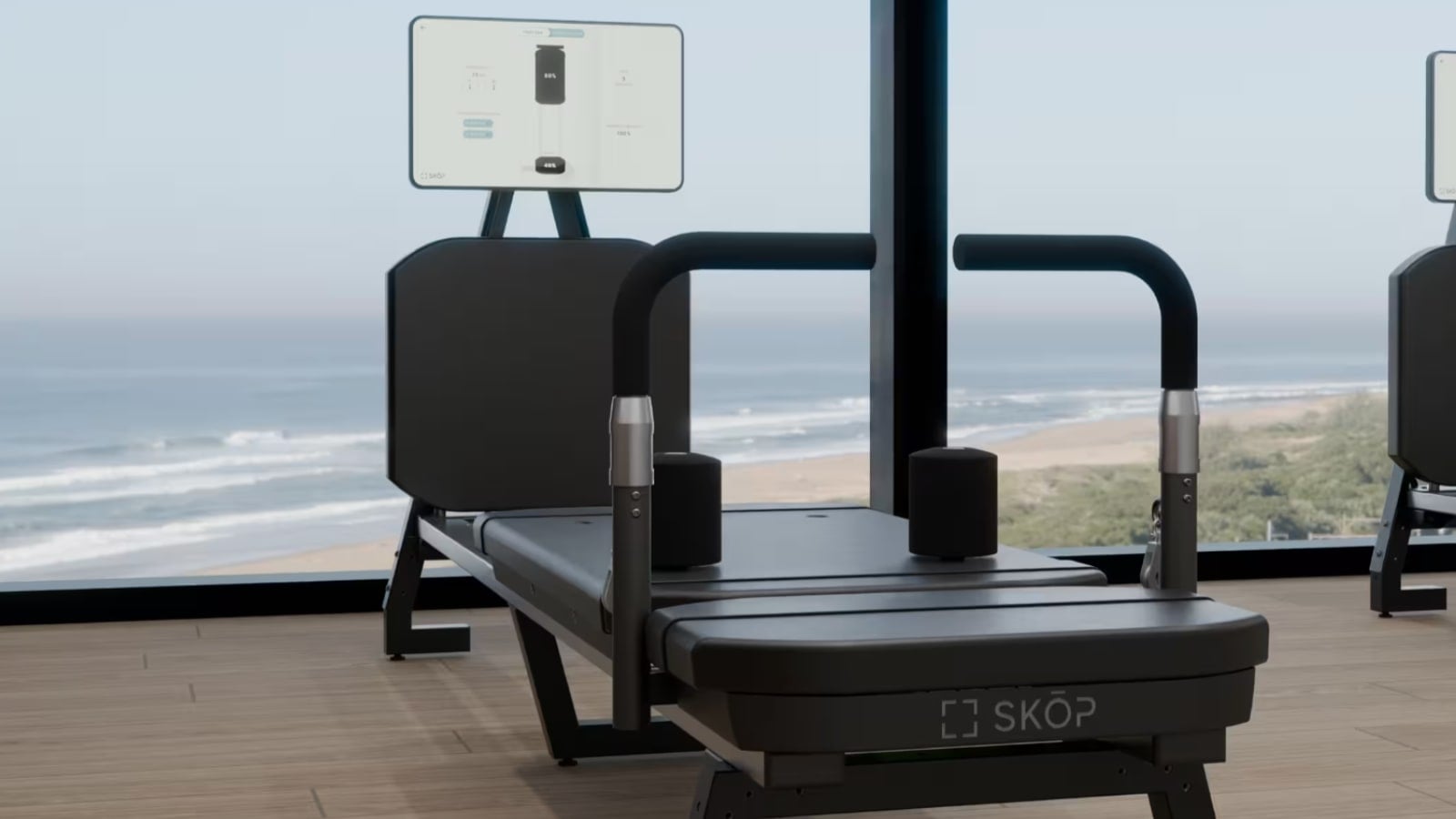
As mentioned above, Peloton is not currently positioning this as turning the Skōp machine into a Peloton product. The language throughout is about technology, expertise, and R&D, which suggests Peloton is after the building blocks behind Skōp, likely including some of its team, rather than the reformer itself. For now, no new Peloton product or member-facing feature has been announced.
Skōp was founded in 2019 by a sports medicine and pre- and postpartum rehabilitation doctor, and billed its machine as “the world’s first connected reformer that measures data in real time.” It was preselling its reformer at a $7,995 introductory price, with a subscription charged separately, and designed the product in California. As of publishing, Skōp’s website has been taken down, with only archived versions showing what it offered.
Skōp was trying to differentiate itself with its form-tracking technology, which gave real-time feedback during a workout. According to archived versions of its site, the reformer measured:
- Weight distribution across the hands and feet
- Pace of movement
- Tension, quantifying the spring resistance being pushed or pulled
- Range of motion
- Repetitions completed
Real-time form and movement tracking is territory Peloton has been building in for years. The Peloton Guide introduced camera-based movement and rep tracking in 2022, and Peloton expanded its AI tracking with Peloton IQ on the Cross Training + devices last fall. Skōp’s form-focused technology sits in that same vein, applied specifically to the Pilates reformer.
Skōp had also marketed its Pilates reformer well beyond the home, pitching it to commercial studios, hotels, and physical therapy and rehabilitation settings, where a “physiotherapy” mode scored a user’s movement against preset “gold standard” data.
The acquisition lands as Peloton leans further into Pilates. The company recently elevated Pilates to a top-level modality in its app and added new Pilates instructors, and it reported that member engagement with its Pilates content rose 48% year-over-year in Q3. In the release, Peloton also cited the 2025 SFIA report calling Pilates the fastest-growing fitness modality in the US, with participation up nearly 40% in recent years, and Google data showing “Pilates” is now the third most searched fitness term behind running and yoga.

It also fits Peloton’s broader strength ambitions. Stern has previously teased new strength products, noting Peloton already has roughly two million members engaging with strength each quarter and sees room to broaden its equipment portfolio across resistance training.
Skōp is Peloton’s second acquisition in recent months, following its purchase of the breathwork app Breathwrk last fall. On Peloton’s most recent earnings call, Stern said the company had meaningful excess cash on its balance sheet and was open to “highly targeted investments,” noting that as one of the few public companies in its corner of the fitness market, Peloton is a common port of call for companies looking for an exit. The targeted framing here lines up with that approach.
Terms of the acquisition were not available at this time.
You can read the full announcement via Peloton’s press release.
We will continue to share updates as Peloton develops its Pilates and strength offerings.
Support the site! Enjoy the news & guides we provide? Help us keep bringing you the news. Pelo Buddy is completely free, but you can help support the site with a one-time or monthly donation that will go to our writers, editors, and more. Find out more details here.
Get Our Newsletter Want to be sure to never miss any Peloton news? Sign up for our newsletter and get all the latest Peloton updates & Peloton rumors sent directly to your inbox.

What’s next for Peloton, deskwork day health? With Unsit or Movably?