

Earlier this year Peloton embarked on a significant global refinancing initiative. As part of this process, the company presented an in-depth overview to potential investors, highlighting its unique value proposition and strategic direction.
This investor presentation provided insight into Peloton’s user demographics and the types of workouts dominating the platform.
Peloton’s mission, as conveyed to investors, is clear:
We power people around the world to be the best version of themselves through personalized fitness and wellness experiences. Peloton couples gorgeously designed hardware with innovative software that seamlessly integrates best-in-class content, including classes from the world’s leading fitness instructors, immersive scenic rides and runs, and motivating gaming experiences. We serve a passionate community of active and engaged members, wherever they are in their fitness journey, so they can reach their goals anytime, anywhere.
As of the presentation’s release, Peloton had around 3.7 million paid subscriptions, encompassing both app and hardware users. This figure, however, represents only a portion of Peloton’s overall user base, which exceeds 6 million when accounting for multiple user accounts per hardware subscription and those using the free app tier.
The presentation also provided a deeper dive into the demographics of their core user base: U.S. hardware owners. The data is accurate as of November 2023 and reveals interesting insights into the member makeup.
First, 67% of U.S. Peloton hardware owners are women, while 33% are men. This means that more than two thirds of Peloton’s connected fitness members are women.
In terms of age distribution, the largest demographic comes from those in the 35-44 age range (which makes up 33% of the user base).
25% of Peloton owners in the US are in the 45-54 age range; 22% are in the 25-34 age range; 14% are in the 55-64 age range; 4% are in the 65-74 age range; and 2% are in the 18-24 or 75+ age range.
As far as income distribution, 24% of members come from households that make $100k-$150k; 22% come from households that make $250k or more; 20% come from households that make $50k-$100k; 19% come from households that make $150k-$250k; 12% come from households that make $200k-$250k; and 4% come from households that make less than $50k per year.

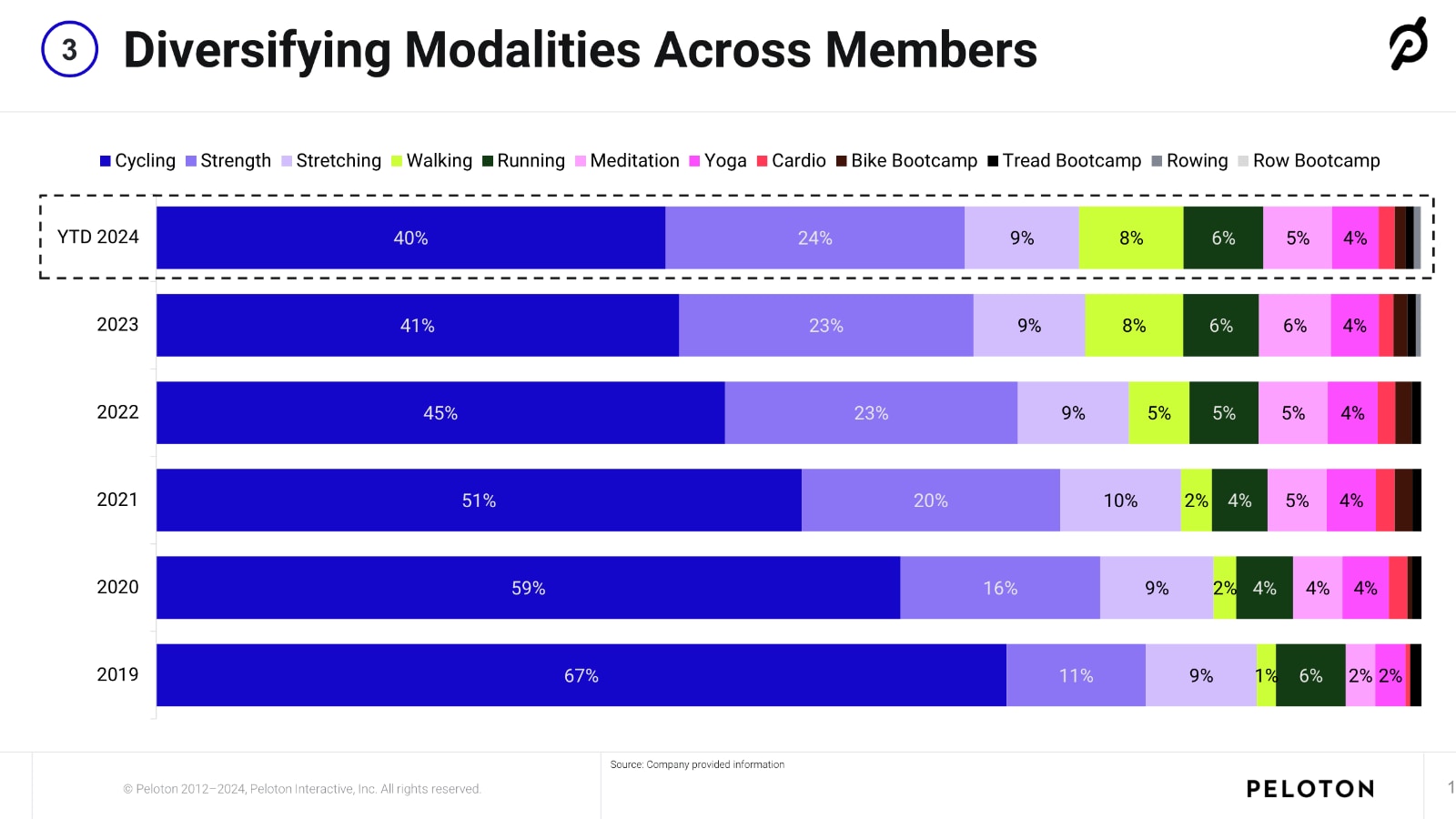
The presentation also shed light on the workout preferences over time of Peloton’s global user base, which includes both app and hardware users. Peloton published a breakdown of workout types, highlighting the popularity of different categories within the Peloton community. In other words, which workout types are being done the most?
As expected, cycling remains the most popular modality, reflecting Peloton’s origins and continued strength in this category. So far in 2024, 40% of classes taken have been cycling classes. Though there has been a steady decline in the overall percentage over the years as Peloton has added fitness formats (which is to be expected as you have people joining the platform who only do running, for example), cycling clearly still dominates among members.
The second most popular modality is strength training, with 24%. This is more than double where the modality stood in 2019, growing steadily over the past five years.
Strength is followed by stretching, accounting for 9%. Almost tied at 8% is walking, followed by running at 6%.
Despite being a long-standing option, yoga has not achieved the same level of popularity as Peloton’s other modalities – sitting at 4%. Meditation accounts for 5%.
The remaining modalities – Cardio, Bike Bootcamp, Tread Bootcamp, Rowing, and Row Bootcamps – account for a small enough percentage of classes taken on the Peloton platform that they are not given percentages on the graphic in the presentation deck. It is worth noting that some of these formats – particularly Rowing and Row Bootcamps – are still quite new.
The numbers surrounding Peloton’s strength modality are particularly noteworthy, as this aligns with the recent developments. First, Peloton announced that they will cease live classes on Wednesdays, a change designed to “carve out dedicated time and space for our Content, Production, and Instructor teams to meaningfully focus on innovation to shape new fitness and wellness experiences for our Members.”
As part of this, Peloton specifically promised that members can expect more strength programming. We recently shared that content featuring barbells – which would be an entirely new piece of equipment to the Peloton platform – could be in the works. These investments in their strength offerings align with the growing user preference for that modality.
These user demographics and modalities information is not data that Peloton regularly shares, thus providing interesting insight into strategy and potential future developments.
Support the site! Enjoy the news & guides we provide? Help us keep bringing you the news. Pelo Buddy is completely free, but you can help support the site with a one-time or monthly donation that will go to our writers, editors, and more. Find out more details here.
Get Our Newsletter Want to be sure to never miss any Peloton news? Sign up for our newsletter and get all the latest Peloton updates & Peloton rumors sent directly to your inbox.

No brainer – offer way more guided rides in addition to the ver few you have. It works for Nordic Trak.
I would love to see data on what types of cycling classes are used. For example power zone 50%, HIIT, 30%,etc.
Bring us kettlebells please!
I love the tread plus. It is expensive but a dream to walk on. It is worth it.