

Two new Peloton patent applications describe workouts that change while a member is taking them, including AI-generated instructor voice cues that react to a member’s performance in real time.
Both applications were published by the U.S. Patent and Trademark Office on Thursday, August 27, 2026, and both list a single inventor: Francis Shanahan, Peloton’s Chief Technology Officer. Both applications were originally filed on February 27, 2025.
The two applications are companion filings built around essentially the same disclosure. They share the same figures and most of the same specification, incorporate one another by reference, and pursue different sets of claims around the same adaptive-workout system.
Real-Time Modification of Audio Content for a Virtual Coach Application
The first application, publication number US 2026/0249138, covers changing what an instructor says to you in the middle of a workout.
The claims describe generating a modified voice transcript using a large language model associated with the instructor giving the cue. One dependent claim goes further, specifying:
“an existing speech synthesis model for the instructor that is trained using exercise classes taught by the instructor within the connected fitness platform.”
In other words, one version of the system could use a synthetic version of an instructor’s voice to deliver something the instructor never recorded.
The filing names OpenAI’s GPT-4 and Google’s PaLM 2 as examples of generative AI models that could be used, though it does not say Peloton is actually using either system.
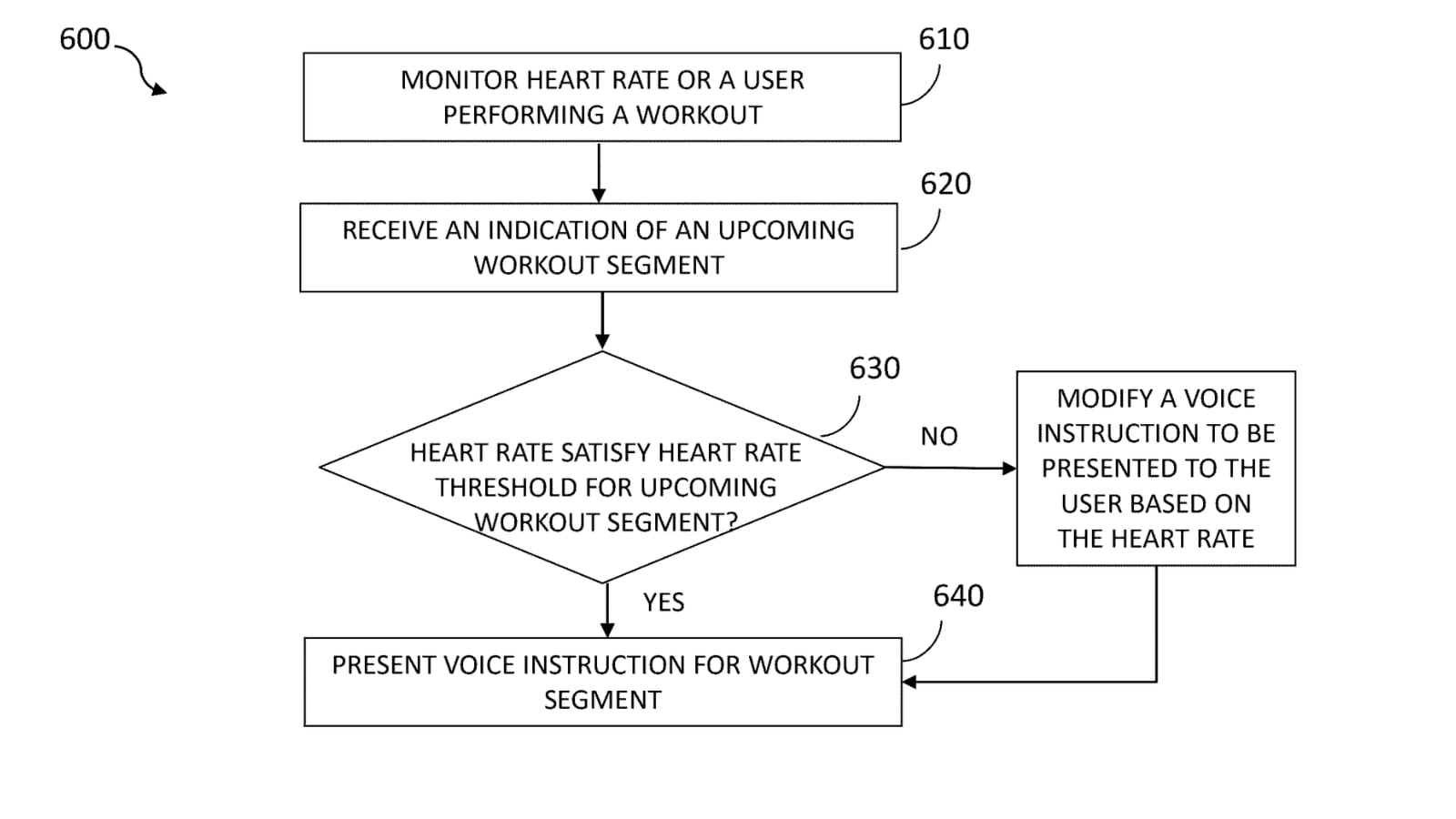
Heart rate is one of the clearest examples in the filing, but the claims go broader than that. The platform can react to sensor and performance data including heart rate, pace, exercise-machine metrics, and data from wearable devices. Trigger events can include reaching the end of a workout segment or the period between two segments.
One claimed implementation monitors a member’s heart rate, receives notice of an upcoming workout segment, and checks whether that heart rate meets the threshold for the segment. If it does, the member hears the cue that was already there. If it does not, the cue can be rewritten before it plays.
Another example walks through what that could sound like during a set of running intervals. A member runs the first interval three seconds too fast, and during the rest interval hears a generated line telling them they went out too fast and should dial it back by a few seconds. They overcorrect and run the next interval too slowly, and the cue that follows is:
“ok, ok, you know that was too slow, let’s meet in the middle for the next one”
The filing says rewritten dialogue can retain “the usual speech patterns and/or idiosyncrasies of the coach,” and the sample cues lean into that idea, repeatedly addressing the member as “pal.”
The system can also change the shape of a workout through audio alone. In one example, a member’s heart rate drops back to the target rate during a rest interval, so the platform starts the next sprint early rather than waiting out the clock, counting the member in from five.
In another, the platform determines a member’s heart rate has remained above their normal range for the entire session and ends the workout early with a line telling them to cool down instead. The application notes that modified instructions could also be delivered through text or closed captions rather than spoken audio.
Peloton does already replace instructor audio with synthetic audio in the AI-dubbed Spanish and German classes that began rolling out in April.
Those work differently, though. The dubbed classes use an AI-generated voice to translate what the instructor actually said. This application describes generating entirely new coaching based on what the member is doing during the workout.
Real-Time Modification of Workouts Within a Connected Fitness Platform
The second application, publication number US 2026/0249137, covers the class itself changing, or taking different branches.
Peloton describes inserting “inflection points” into a class, flagged by timestamps and metadata inside the class video stream. When playback reaches one, the platform can either offer the member a set of choices or select the next segment automatically based on sensor or performance data.
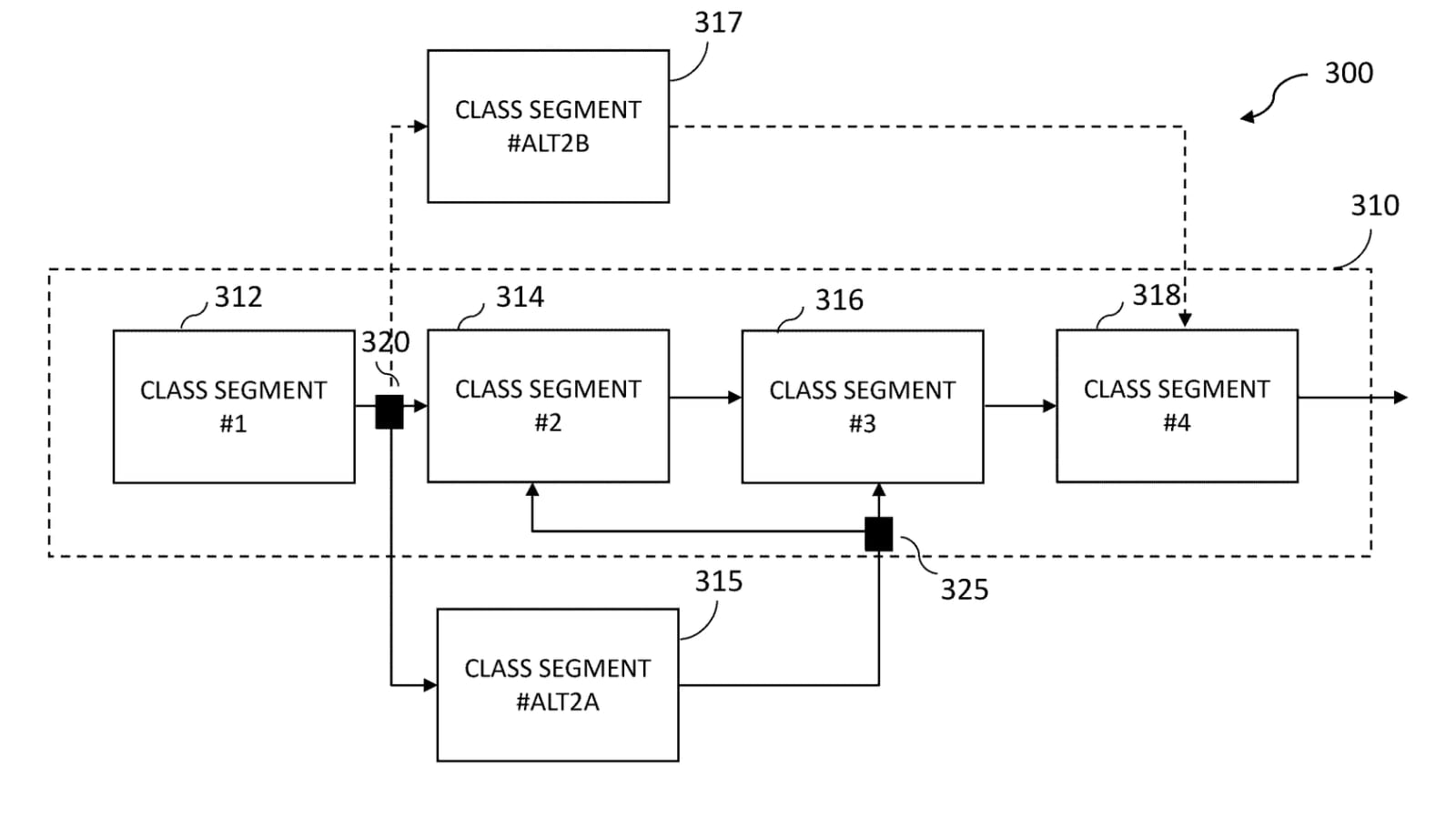
The member-facing version puts the options on screen. After a treadmill warmup, the filing’s example prompts read “Are you ready to go?”, “Do you need more warmup time?” and “Do you want to stretch a bit?” Choosing the second one inserts more warmup before the run starts.
A separate scenario has a class asking “Ready for more hills?” or “Ready to descend?” after a hills block, with the first choice replacing the beginning of the descent section with another hills section and pushing the descent later.
The automatic version skips the prompt entirely. In that example, a member’s heart rate is already in the target zone coming out of the warmup, so the platform determines they are ready and moves them straight into the first hard effort.
The filing also describes making those decisions from other performance data. One example says the platform could determine that a member’s performance falls within the “top X percentage of users,” potentially allowing the workout to branch based on how the member is performing relative to others.
In both versions the platform can insert a segment, remove one, replace the next one, or shorten and lengthen what is already there.
The filing does not describe generating new instructor video on the fly. Instead, a class can contain alternate workout segments available at different inflection points, with the software determining which pieces to play and in what order.
A strength example has the system notice a member reached failure one rep early on their second-to-last set, cut the final set from ten reps down to six, and generate a cue explaining the change. That is where the concepts covered by the two applications come together.
The filings are not limited to Peloton hardware, either. One scenario has a member running outside with a smartwatch capturing heart rate, speed, distance, time, elevation and other data.
Another follows a cyclist attempting to complete a century ride in under six hours. When the system determines the rider is behind the necessary pace but capable of working harder, it can generate coaching telling them to increase their speed by one mile per hour for ten minutes. Coaching can be delivered through a mobile device, and the filing also contemplates text or closed-caption instructions through devices such as smart glasses.
Peloton already has many of the building blocks described in the applications.
The Cross Training devices and Peloton IQ brought a movement-tracking camera, rep counting, form feedback and suggested weights. Peloton IQ also incorporates workout history and performance data alongside third-party activity data from Apple Health, Garmin and Fitbit.
Cardio Performance Estimates already predict how a member will perform in a class before they take it. Pace Targets already let a single running class ask different speeds of different members based on the level they set. Peloton has also said it wants to bring personalized feedback to more class types.
What Peloton’s current features do not do is change the underlying instructor-led class content or sequence while the member is taking it – yet.
Peloton’s in-app AI chatbot for building Personalized Plans works on a member’s schedule. The ChatGPT integration helps pick classes. Both stop at the moment a member presses start, while these two applications describe what could happen after that.
The applications themselves frame that fixed-class experience as the problem they are trying to solve, describing conventional connected-fitness workouts as “static and inflexible” once a member begins them. Elsewhere, the specification describes the concept as enabling a type of “choose your own adventure” workout.
That lines up closely with how CEO Peter Stern has described Peloton’s broader AI strategy since the applications were filed. In his January 2026 annual letter, Stern said AI could allow Peloton to move beyond “counting and tracking what you did” toward “personalizing and coaching you on what to do.”
Generated instructor cues could also allow that personalized coaching to scale without requiring an instructor to return to the studio every time Peloton wants to create another possible response or workout path.

Neither application uses the Peloton IQ name, but both were filed more than seven months before Peloton publicly unveiled Peloton IQ and the Cross Training Series in October 2025.
As always, features that show up in patent applications don’t always make it to products or features that see the light of day. In other words – just because Peloton filed a patent application, doesn’t mean these are definitely new features that Peloton will be adding – though it is easy to see how they fit into Peloton’s recent push into AI.
Peloton has not announced anything specifically connected to either of these new applications.
Would you want a Peloton class that changes based on how you are performing while you are taking it?
Support the site! Enjoy the news & guides we provide? Help us keep bringing you the news. Pelo Buddy is completely free, but you can help support the site with a one-time or monthly donation that will go to our writers, editors, and more. Find out more details here.
Get Our Newsletter Want to be sure to never miss any Peloton news? Sign up for our newsletter and get all the latest Peloton updates & Peloton rumors sent directly to your inbox.

Boo to ‘AI’ cues.
I do exercise to escape AI / not have it embedded into everything I do in life. This is a huge mistake from Peloton and if they roll it out and my experience is different, I will instantly leave and move to another platform.